The takeaway
Dietary nitrate can support performance in some settings. A plate of roasted golden beets is not a measured performance dose.
Where the performance claim comes from
The interest in beetroot starts with dietary nitrate. Bacteria in the mouth help turn nitrate into nitrite, which the body can then convert into nitric oxide. Nitric oxide helps regulate blood flow and muscle function. Under some conditions, nitrate supplementation can also reduce the oxygen cost of exercise.[1]
That gives us a plausible mechanism and some promising results. It does not mean every beetroot meal will make every athlete faster.
What do the studies actually show?
A small crossover study in 11 recreationally fit adults tested 200 g of baked beetroot before a 5 km run. Overall running speed did not reach statistical significance (p = 0.06). The final 1.8 km was 5% faster (p = 0.02). That specific result is interesting; it is not a promise of a 5% improvement over an entire race.[2]
A 2026 review combined 45 trials involving 659 athletes. It found no statistically significant pooled benefit for the six outcomes assessed: peak power, mean power, maximal oxygen uptake, heart rate, blood lactate, and perceived exertion. These measures do not cover every possible race outcome. The authors describe potential benefits as small and dependent on context.[3]
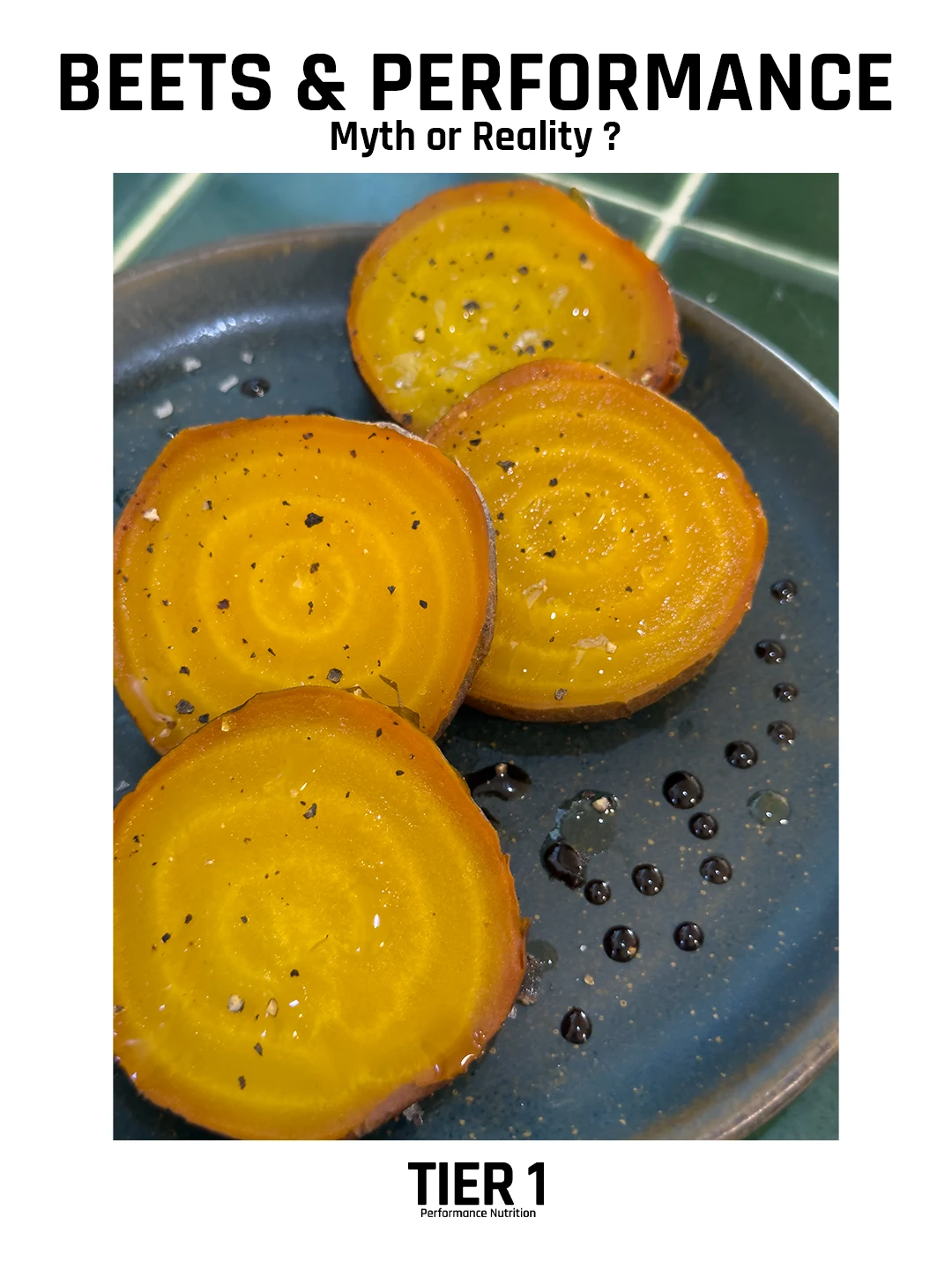
What about the golden beets on this plate?
Golden beets can contain nitrate, too. Research comparing beetroot varieties included the yellow cultivar Burpees Golden and found that nitrate content varied with genotype and growing conditions. Color alone cannot tell us the nitrate content of a serving, or establish the same performance effect as a tested beetroot supplement.[4]
The Australian Institute of Sport also notes that homemade beetroot preparations may not deliver a reliable nitrate dose for acute supplementation. We have not measured the nitrate in the beets pictured here, so we cannot assign them a performance-effective serving size.[5]
A serving of beets is not a nitrate dose
For context, Australian Institute of Sport guidance describes 6–8 mmol of nitrate (approximately 350–500 mg) consumed 2–3 hours before exercise. Those numbers refer to nitrate itself, not grams of beetroot or beetroot powder. They describe a supplementation protocol, not a measured property of this dish or a personalized recommendation.[6]
From our kitchen: keep it simple
Here is Bruce’s method for the golden beets pictured here. Timing depends on their size; tenderness is the useful test.
- Heat the oven to 400°F (about 200°C).
- Wash the beets and leave the skin on.
- Bake until a knife slides in with little resistance, usually around an hour.
- Let them cool enough to handle, then slice and serve.
Our take
Enjoy the beets. They belong on the plate because good food should taste good and fit the way you eat. The performance research is worth understanding, but it does not turn an unmeasured serving of roasted vegetables into a guaranteed training advantage.
Read the evidence
Research & sources
The papers and guidance behind this article. Links open the original source in a new tab; some publishers may limit access to the full text.
Australian Institute of Sport · Guidance
Dietary nitrate / beetroot juice: What is it?The nitrate–nitrite–nitric oxide pathway and the rationale for exercise research.
Journal of the Academy of Nutrition and Dietetics · 2012 · Crossover trial
Whole Beetroot Consumption Acutely Improves Running PerformanceA small trial in 11 adults. The full-run result and final-segment result should be interpreted separately.
Sports · 2026 · Systematic review and meta-analysis
Dietary Nitrate Supplementation and Exercise Performance in Athletes: A Systematic Review and Meta-Analysis of Randomised Controlled Trials45 trials and 659 athletes; six performance, physiological, and perceptual outcomes.
Molecules · 2020 · Cultivar study
Bioactive Compounds and Total Sugar Contents of Different Open-Pollinated Beetroot Genotypes Grown OrganicallyMeasured variation in beetroot composition, including a golden cultivar. This was not an athlete performance trial.
Australian Institute of Sport · Guidance
Dietary nitrate / beetroot juice: What does it look like?Why nitrate content varies and homemade preparations do not guarantee a known dose.
Australian Institute of Sport · Guidance
Dietary nitrate / beetroot juice: How and when do I use it?Nitrate dose and timing guidance for studied supplementation strategies.
Sources checked November 24, 2026.